Hyperliquid Stock Perps When Nasdaq Is Closed
Researched and written by Concept211 from Entropy's own docs, its public API and on-chain data. Not sponsored, reviewed or approved by Entropy, Bursa Global or Hyperliquid. We earn a referral share if you sign up through our link. How we research
Table of Contents
- What happens to a stock perp's price when Nasdaq closes
- Weeknights are not the closed case
- The internal oracle
- The mark price, and the cap on it
- Market hours against closed hours
- Funding over weekends and holidays
- Liquidation risk around the reopen
- Worked example: the November 8 Nvidia selloff
- How to size and set stops for a weekend hold
Warning
EntropyGuides is an independent, unofficial guide. We are not affiliated with Entropy, Bursa Global Inc., trade.xyz, Hyperliquid, the Hyper Foundation or Hyperliquid Labs. The stock perps on this page are deployed by trade.xyz, not by Entropy. Nothing here is financial, legal or tax advice.
Short answer:  trade.xyz's stock perps on
 Hyperliquid keep trading when Nasdaq is shut. From Friday 8:00 PM to Sunday 8:05 PM ET, and on market holidays, the oracle stops following an outside price and moves with the perp's own order book. The mark price is capped within plus or minus 1/max leverage of Friday's close (5% for NVDA, 10% for NBIS, CRWV and INTC). Funding keeps paying hourly. Liquidations keep running. The real risk is the moment outside pricing comes back.
- Weekends price off the perp itself. Between Friday 8:00 PM and Sunday 8:05 PM ET, trade.xyz's oracle is an EMA of its own order book, starting from Friday's last outside price.
- The move is capped, then the cap moves. NVDA's mark can travel 5% from the reference before re-anchoring, twice per direction. NBIS, CRWV and INTC get 10% and one re-anchor.
- Funding and liquidations never stop. The gap risk sits at the reopen, when the oracle snaps back to the outside price on the next tick.
This page covers the four trade.xyz equity perps our readers trade most: NVDA, NBIS, CRWV and INTC. Everything below comes from trade.xyz's documentation and Hyperliquid's HIP-3 docs, read on November 10, 2026, with the source linked at each point. If you are new to how deployer markets work on Hyperliquid, HIP-3 explained is the background.
What happens to a stock perp's price when Nasdaq closes
A stock perp needs a reference price every few seconds. Hyperliquid's HIP-3 rules make the deployer responsible for it: deployers are expected to call setOracle every 3 seconds even with no change (Hyperliquid, HIP-3 deployer actions). The question is where trade.xyz gets that number when the stock isn't trading anywhere.
Weeknights are not the closed case
People often assume "after hours" means the perp is on its own. For US stocks it isn't. trade.xyz's relayer takes outside prices 24 hours a day, five days a week, from Sunday 8:05 PM ET to Friday 8:00 PM ET. That covers pre-market (4:00 to 9:30 AM), the regular session, post-market (4:00 to 8:00 PM) and an overnight session from 8:05 PM to 4:00 AM, which comes from Blue Ocean ATS (trade.xyz, US stocks).
So on a Tuesday night, xyz:NVDA still has an outside anchor. The window with no outside price at all is Friday 8:00 PM to Sunday 8:05 PM ET, plus equity market holidays. trade.xyz moved the end of that window from 8:00 to 8:05 PM on August 13, 2026, and says internal pricing "continues to follow applicable equity market holidays and trading hours" (trade.xyz changelog). Its holiday page lists November 26 and December 25 as closed, and November 27 and December 24 as 1:00 PM early closes (holiday closures).
The internal oracle
When outside data stops, trade.xyz's oracle "initializes from the last available external price" and then moves by an exponentially weighted moving average of the impact price difference: how far the average fill price for a set order size, on the bid side or the ask side, sits from the current oracle (trade.xyz, oracle price).
Two parameters set its speed. The time constant is 30 minutes, and the elapsed time counted per update is capped at a tenth of that. The docs work out that any one update can move at most about 9.5% of the way toward the order book's price. Our reading: a lasting shift in the book pulls the oracle along over minutes, while one stray print moves it only a little.
When outside data comes back, the docs state that "the oracle reverts to the externally derived price on the next tick". There is no blending period.
The mark price, and the cap on it
The mark price is what triggers liquidations, and on trade.xyz it is the median of three things: the oracle, the oracle plus a 150-second EMA of the gap between the book's mid and the oracle, and the median of best bid, best ask and last trade. Relayer updates are clamped to plus or minus 50 basis points of the current value, for both the oracle and the mark (trade.xyz, mark price).
On top of that sit discovery bounds. trade.xyz restricts the mark price to within plus or minus (1 / max leverage) of a reference price. Over a weekend that reference starts at Friday's last outside price. When the oracle gets close to the edge of a bound and hits a trigger threshold, the reference re-anchors to the bound and a fresh bound forms around it. Each market has a set number of these re-anchors per direction. After the last one, "the bound becomes a hard cap until external pricing resumes" (trade.xyz, discovery bounds).
The four markets on this page, from trade.xyz's specification index:
| Market | Max leverage | Discovery bound | Re-anchors per direction | Margin mode | Funding multiplier |
|---|---|---|---|---|---|
| xyz:NVDA | 20x | ±5% | 2 | Cross | 0.5 |
| xyz:NBIS | 10x | ±10% | 1 | Isolated | 0.5 |
| xyz:CRWV | 10x | ±10% | 1 | Isolated | 0.5 |
| xyz:INTC | 10x | ±10% | 1 | Cross | 0.5 |
Higher max leverage means a tighter weekend bound. NVDA gives you 20x and only 5% of room before it has to re-anchor, which surprises people who expect the bigger market to have more slack. The same formula covers trade.xyz's other stock perps: Micron's xyz:MU, listed at 10x on November 20, 2026, gets a ±10% weekend bound.
Market hours against closed hours
| Outside price live (Sun 8:05 PM to Fri 8:00 PM ET) | Internal session (Fri 8:00 PM to Sun 8:05 PM ET, holidays) | |
|---|---|---|
| Oracle | Outside fair price from the relayer's data sources | EMA of the perp's own impact prices, starting from Friday's last outside price |
| Discovery bound reference | Last outside fair price | Friday's last outside price, then re-anchored levels |
| Re-anchor counters | Reset to zero when outside pricing resumes | Count up; a hard cap once used up |
| Funding | Hourly, standard formula × 0.5 | Hourly, standard formula × 0.5, against the internal oracle |
| Liquidation | Against trade.xyz's relayer mark price | Same, but not while your liquidation price is outside the active bounds |
Funding over weekends and holidays
Hyperliquid pays funding every hour. The premium is sampled every 5 seconds and averaged over the hour, and the rate is capped at 0.5% per hour. HIP-3 markets use a more responsive premium: the midpoint of the impact bid and impact ask, divided by the oracle, minus one (Hyperliquid, funding).
trade.xyz multiplies the whole formula by 0.5 on every market. Its December 19, 2025 changelog says this lowers baseline funding to about 5.5% annualized and "results in less aggressive funding during weekend price discovery as well" (trade.xyz changelog). The docs describe no weekend pause and no separate weekend multiplier.
What that means for a weekend hold: funding is charged against the oracle, and over the weekend the oracle is the order book's own EMA. If one side crowds in and the book's impact prices pull away from the oracle, you pay a premium every hour for as long as that lasts, at half the size you'd pay on a native Hyperliquid perp. Our funding rates tool shows live rates across markets.
 Entropy prices its own SanDisk perp differently. Its off-hours funding multiplier drops from 0.5 to 0.125, and its overnight band holds fixed instead of re-anchoring. The io:SNDK guide walks through that model, and Entropy vs trade.xyz compares the two venues more broadly.
Liquidation risk around the reopen
Liquidations don't pause on a weekend. trade.xyz's liquidation engine uses its own relayer mark price for xyz markets, and a backstop liquidation kicks in if account equity drops below two thirds of maintenance margin (trade.xyz, liquidation mechanics).
The discovery-bounds page adds one rule that cuts both ways: "If a trader's liquidation price lies outside the active price bounds, their position cannot be liquidated while those bounds are in effect." While the mark is pinned at a hard cap, a position whose liquidation price is past the cap survives the weekend. It only delays the problem. When outside pricing resumes, the reference jumps to the live outside price, the counters reset, and the oracle moves to the outside price on the next tick. If the real price is already past your liquidation level, you find out right then.
For trade.xyz US stocks, that moment is Sunday 8:05 PM ET, when the Blue Ocean overnight session starts feeding prices, not the 9:30 AM Monday bell. A second gap can come at the Nasdaq open if the opening auction prints well away from where overnight trading left off, as it did on November 9.
Hyperliquid's own limits also apply to every HIP-3 market: deployer mark updates are clamped to 1% from the previous mark, and all prices are clamped to 10 times the start-of-day value (HIP-3 deployer actions). The docs don't spell out how those clamps play out against a large reopen gap, so we won't guess.
Worked example: the November 8 Nvidia selloff
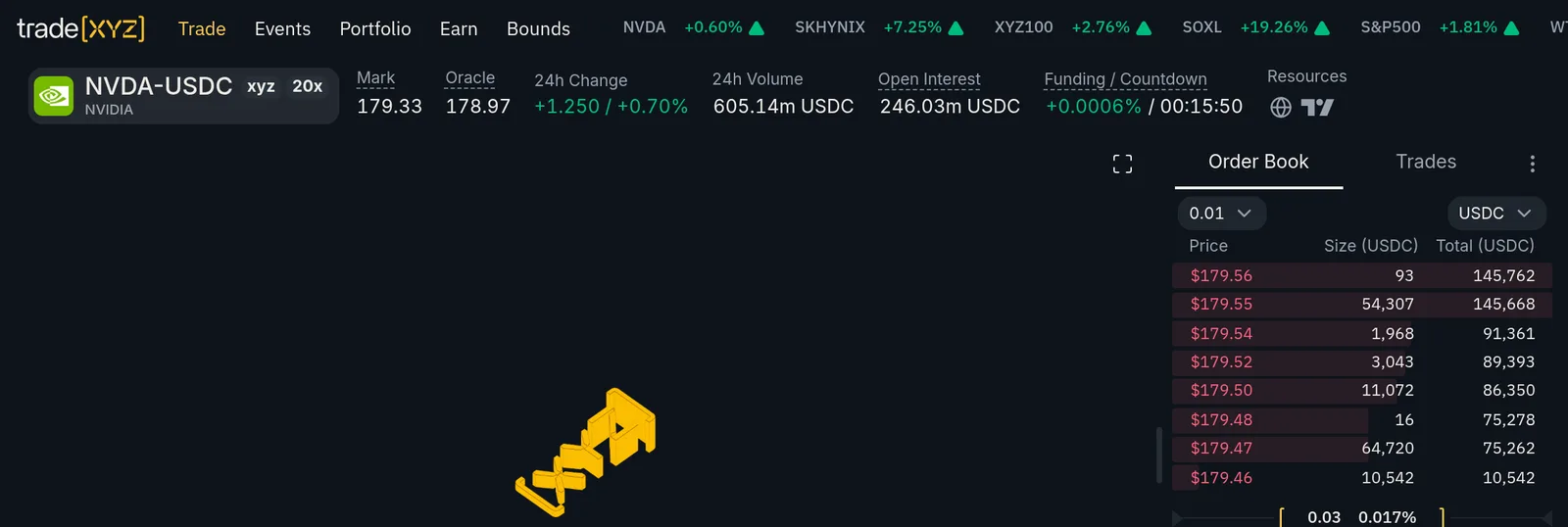
On Sunday, November 8, 2026, the news broke while Nasdaq was closed and before the Sunday evening outside session started, so the xyz:NVDA order book was the only live Nvidia price.
- Friday close: Nvidia closed at $186.64 on Nasdaq (Finance Magnates, also on TradingView).
- The news: Nvidia said it was opening an investigation into CEO Jensen Huang's relationship with a woman reportedly identified by intelligence officials as a Chinese spy (The Block).
- Sunday afternoon: CNBC reported that bearish bets began around 3:00 PM ET, and that "Hyperliquid's xyz contract" slipped to as low as $180.15 on $200 million of volume by 3:30 PM ET (CNBC).
- Sunday night: The Block reported NVDA-USDC perps down 3.8% over 24 hours to $180.50 as of 10:10 PM ET, after a slide that began around 4:00 PM ET and a local low near $178.10, on $170 million of 24-hour volume. Finance Magnates cited Reuters putting both the perp and Blue Ocean after-hours trading near $180.30, about 3.4% below Friday's close.
- Overnight: CNBC reported both the shares and the perps fell below $178.
- Monday: The stock "opened 8 per cent lower on the Nasdaq before recouping some losses" (The Globe and Mail) and closed 4.27% lower (CNBC).
The next part is our own arithmetic, not anything trade.xyz published. A 5% bound on a $186.64 reference puts the first lower bound near $177.31. The reported Sunday low of about $178.10 is roughly 4.6% below the Friday close, so the weekend move used most of NVDA's first 5% band. trade.xyz doesn't publish NVDA's re-anchor trigger threshold, so we can't say whether a re-anchor fired. The 24-hour percentages also differ between reports because each one measures from a different starting point: The Block's 3.8% and the 4.54% Finance Magnates gives are changes in the perp's own price over 24 hours, while the 3.4% is measured against Friday's close.
Monday morning mattered more. Sunday's perp price said roughly 3% to 5% down. The Nasdaq open printed about 8% down before recovering to a 4.27% loss by the close. A 20x long sized on Sunday's price had, for a moment, nearly double the drawdown the weekend market showed. A 20x position's initial margin is 5% of its size, and it is liquidated before a 5% adverse move wipes that out, so a long opened at 20x near Friday's close would have been liquidated during Sunday's slide.
How to size and set stops for a weekend hold
None of this is advice on whether to hold. These are the mechanical points that follow from the documented rules.
- Size for the open, not the bound. The discovery bound caps the weekend mark. It doesn't cap Sunday evening or Monday morning. November 9 showed an 8% opening gap on a stock with a 5% weekend bound. Put your liquidation price past the move you'd survive at the open.
- Leverage and the bound move together. NVDA's 20x maximum comes with a 5% bound, and a 20x position's liquidation sits inside 5%. At 10x on NBIS, CRWV or INTC the bound is 10%, which is about where a 10x position's liquidation sits. Max leverage on these markets is the edge of the weekend range, not a sensible weekend size. Run your numbers through the position calculator first.
- Stops trigger on the mark. On a weekend the mark is set by the order book, and the book is thinner than on a weekday. A stop can fill well away from its trigger, or the mark can sit pinned at a hard cap while your stop never triggers.
- Know your margin mode. NBIS and CRWV are isolated only, so other account balance can't rescue them. NVDA and INTC allow cross margin, which keeps a position alive longer but puts the rest of the account behind it.
- Check the holiday calendar. Internal pricing follows equity market holidays, so Thanksgiving (November 26) is a closed day on trade.xyz's calendar and November 27 is a 1:00 PM early close.
If you're getting "order rejected" messages near a bound, why you cannot open a position covers the common causes. Our methodology page explains how we source and date the figures on this site.
Get a 25% Rebate on Every Trade
Sign up through our link and Entropy attaches its 25% referral benefit to your account automatically, paying back a share of every trade for as long as you trade. It can only be attached at signup and can never be added afterwards, so anyone who arrives without one pays the full rate permanently.
Claim Your 25% RebateFrequently Asked Questions
Yes. trade.xyz stock perps such as xyz:NVDA and xyz:NBIS trade 24/7 on Hyperliquid. From Friday 8:00 PM to Sunday 8:05 PM ET, and on US equity holidays, there is no outside price, so trade.xyz's oracle moves on its own order book instead, inside a limit called a discovery bound.
trade.xyz caps the mark price at plus or minus one divided by max leverage around a reference price. NVDA has 20x max leverage, so its bound is 5 percent, with 2 permitted re-anchors per direction. NBIS, CRWV and INTC have 10x leverage, a 10 percent bound and 1 re-anchor. Once the re-anchors are used up the bound is a hard cap until outside pricing resumes.
No. Hyperliquid pays funding every hour and trade.xyz's documentation describes no weekend pause. trade.xyz scales the standard Hyperliquid funding formula by 0.5 on all its markets, which it says gives less aggressive funding during weekend price discovery. Funding is computed against the oracle, which over the weekend is the internal price.
Yes, if the mark price reaches your liquidation price. trade.xyz liquidates against its own relayer mark price. Its documentation also states that if your liquidation price lies outside the active discovery bounds, the position cannot be liquidated while those bounds are in effect. The risk then moves to the moment outside pricing returns and the bounds reset.
The Block reported that NVDA-USDC perps on Hyperliquid fell 3.8 percent over 24 hours to 180.50 dollars as of 10:10 PM ET Sunday, after reports about CEO Jensen Huang, with a low around 178.10 dollars. Nvidia had closed at 186.64 dollars on Friday. On Monday the stock opened 8 percent lower on Nasdaq, according to The Globe and Mail, and closed 4.27 percent lower, according to CNBC.
Independent resource: EntropyGuides is an independent, third-party resource operated by Concept211. It is not affiliated with, produced by, reviewed by or endorsed by Entropy, Bursa Global Inc., Hyperliquid, Hyper Foundation or Hyperliquid Labs. "Entropy", "Hyperliquid" and related names and marks belong to their respective owners and are used here only to identify the platforms this site documents. Read the full disclaimer.
Not advice: Nothing on this site is legal, tax, financial or investment advice. Descriptions of regulatory status, tax treatment and market availability are general information that varies by jurisdiction and changes over time. Confirm anything that matters to you with a qualified professional and against primary sources. Trading perpetual futures involves substantial risk of loss, and past performance does not indicate future results.
Disclosure: this site contains referral links. Signing up through our referral link applies an automatic rebate to your account and earns us a share of the fee Entropy already charges, at no extra cost to you. The rebate is quoted against Entropy's roughly 50% share of the fee, so the entry tier's headline 25% works out to about 12.5% of what you actually pay.
Get a 25% Rebate on Every Trade
Sign up through our link and Entropy attaches its 25% referral benefit to your account automatically, paying back a share of every trade for as long as you trade. It can only be attached at signup and can never be added afterwards, so anyone who arrives without one pays the full rate permanently.
Claim Your 25% Rebate